
The best Model Context Protocol (MCP) tools for building AI agents in November 2026 are the GitHub MCP Server, Playwright MCP and Context7 on the server side, Composio and the Docker MCP Toolkit for running many servers behind one connection, and FastMCP plus the OpenAI Agents SDK (software development kit) for building your own. Below are 20 picks in three groups (servers, gateways, and SDKs), each with its transport, auth, price and a setup line, all checked on the vendor’s own pages in November 2026.
Key takeaways
- Start with three to five servers, not thirty. Every tool definition you load costs context, and Anthropic’s own guidance is that “more tools don’t always lead to better outcomes.”
- Prefer official, vendor-run remote servers with OAuth (GitHub, Notion, Atlassian, Stripe, Sentry, Supabase). Most community servers are fine for experiments and risky in production.
- The protocol changed this year. The 2026-07-28 spec made MCP stateless and dropped the old session handshake, so check that a server’s SDK is current before you depend on it.
- Gateways (Composio, Docker, Zapier, n8n) handle auth and server sprawl, so several agents can share tools without wiring every API key into each one.
- Treat every server as code that runs with your credentials. Most of the best-known public MCP incidents came from prompt injection through ordinary data rather than bugs in the servers.
What are MCP tools?
The Model Context Protocol (MCP) is an open standard Anthropic released on November 25, 2024 for connecting AI applications to outside tools and data. In December 2025 it was donated to the Agentic AI Foundation, a Linux Foundation fund whose platinum members include Anthropic, OpenAI, Google and Microsoft.
Large language models (LLMs) can only act on the world through the tools you give them, and MCP standardizes how those tools are described and reached. Three words cover most of what you need:
- An MCP server is a program that exposes tools (and optionally resources and prompts) for one system, such as GitHub or a database.
- An MCP client is the part of your agent or app that connects to servers, lists their tools and calls them.
- A tool is one action with a name, a description and a JSON input schema. The LLM reads those descriptions and decides which tool to call.
The spec defines two standard transports: stdio, where the client launches the server as a local subprocess and they exchange newline-delimited messages, and Streamable HTTP, where each message is an HTTP POST to a remote endpoint. The older HTTP+SSE (Server-Sent Events) transport was deprecated in the March 2025 revision. Clients find tools with a tools/list request and run them with tools/call.
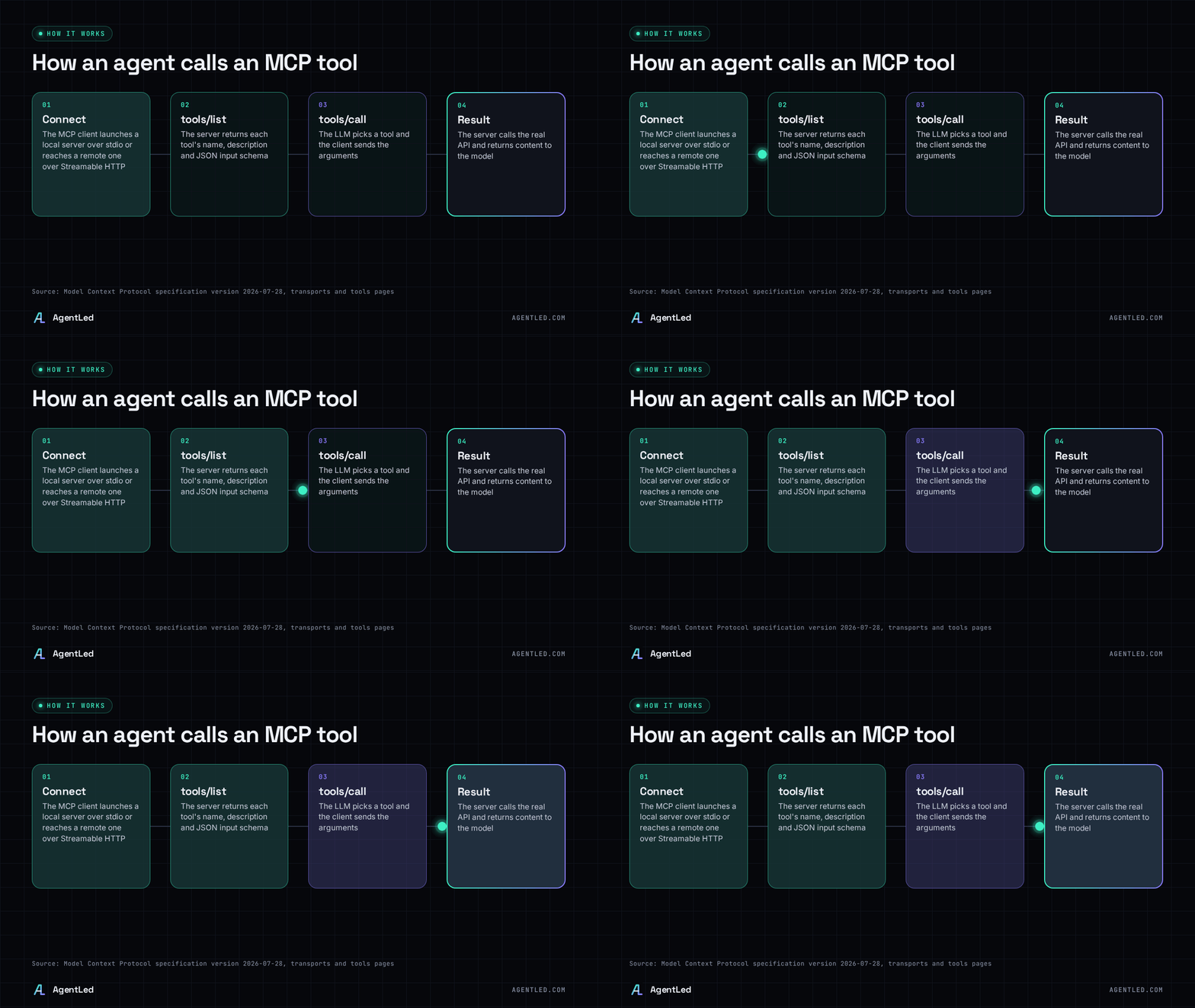 How one MCP tool call works, based on the transports and tools pages of the MCP specification, version 2026-07-28.
So “MCP tools for building AI agents” covers three layers, and this list ranks each one separately:
- Servers your agent calls (GitHub, a browser, a database, docs).
- Gateways and hosted platforms that run, secure or bundle many servers behind one connection.
- SDKs and agent frameworks you use to write your own servers or to connect an agent to existing ones.
How we ranked them
We scored each tool on evidence we could check, in this order:
- Who maintains it. Vendor-run servers beat community forks of the same API.
- Maintenance. Recent commits and releases in the project’s own repository or changelog.
- Transport and auth. Remote Streamable HTTP with OAuth ranks above a local server that needs a long-lived API key in a config file.
- Safety controls. Read-only modes, project scoping and tool filtering.
- Context cost. Fewer, better-designed tools rank higher, following Anthropic’s tool-design guidance.
- Price. A real free tier, and a clear price per call.
GitHub stars are shown for context only. They measure attention, not quality.
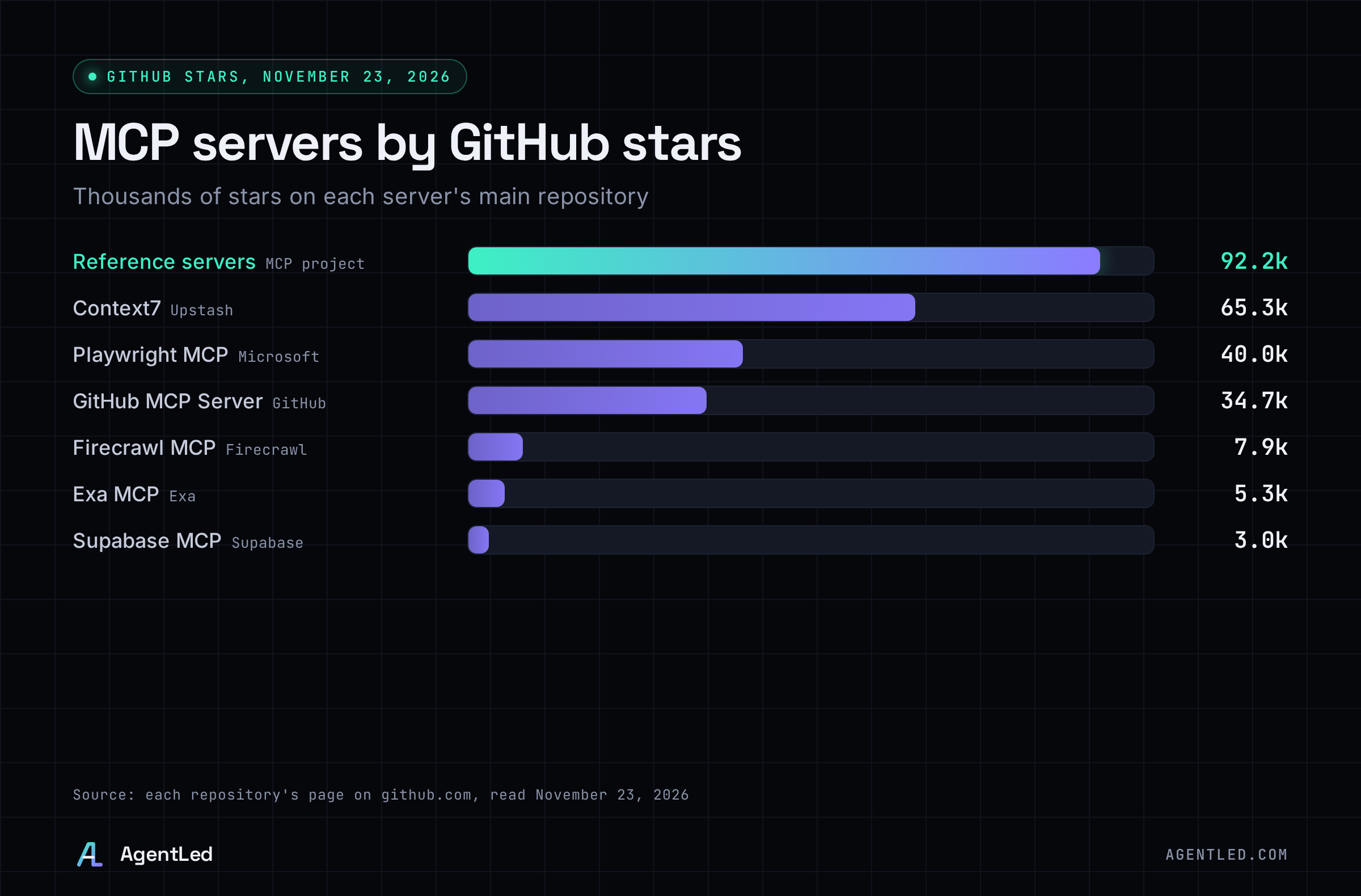 GitHub stars for the open-source servers on this list, read from each repository’s page on November 23, 2026.
The best MCP servers for building AI agents
1. GitHub MCP Server
The GitHub MCP Server is GitHub’s official server for repositories, issues, pull requests, Actions and code security. It appears on nearly every “best MCP servers” list that ranks for this topic.
- Who it’s for: any agent that reads or changes code on GitHub.
- Transport: remote at
https://api.githubcopilot.com/mcp/, or local stdio through a binary or theghcr.io/github/github-mcp-serverDocker image. - Auth: OAuth or a personal access token (PAT). The remote server went generally available on September 4, 2025 with OAuth 2.1 and PKCE (Proof Key for Code Exchange).
- Price (November 2026): free for all GitHub users regardless of plan. Tools that wrap paid features, such as Copilot cloud agent, need the matching license.
- Strengths: you can turn on only the toolsets you need (the default set is context, repos, issues, pull requests and users), and
--read-onlyskips every write tool. - Limits: Claude Desktop custom connectors can’t use the remote server yet, so the install guide points Claude Desktop users to the local Docker setup. GitHub’s own docs say its lockdown mode “is a best-effort content filter, not a security boundary.” MIT-licensed, version 2.2.0 released November 16, 2026.
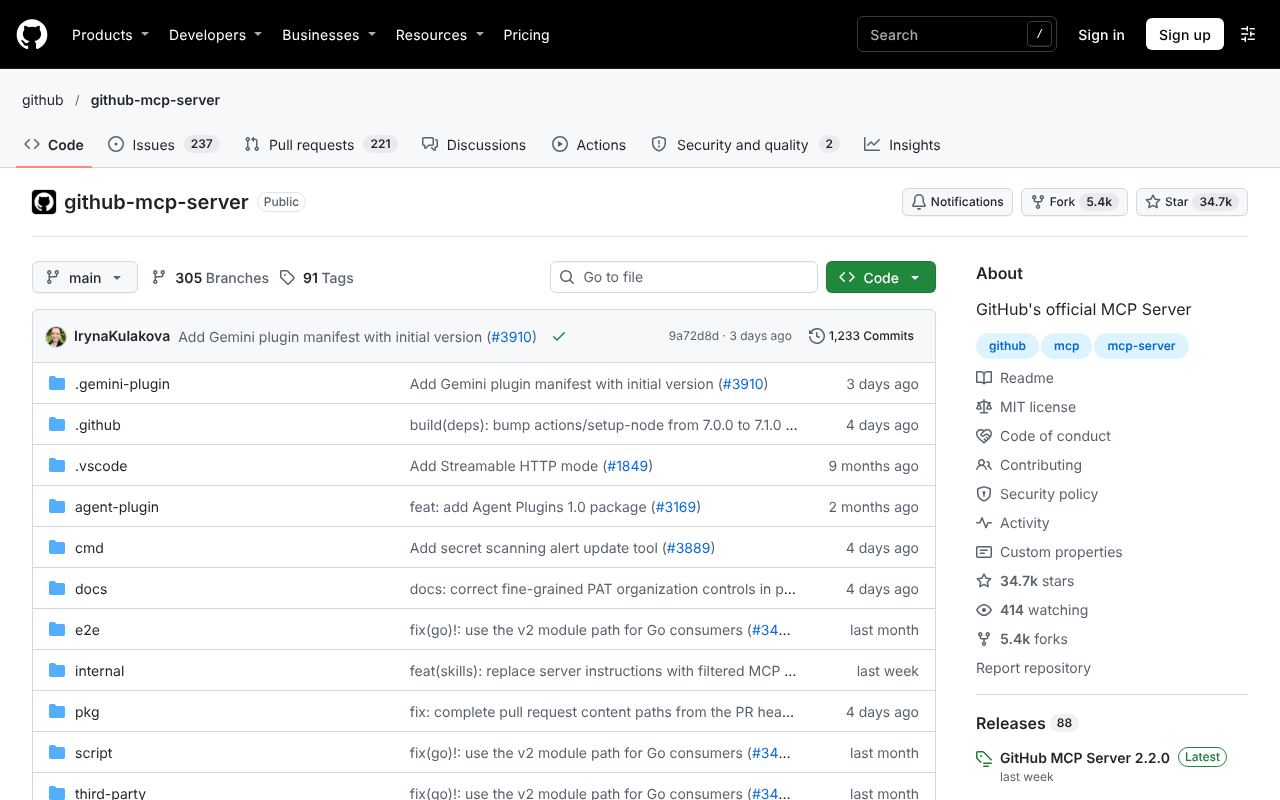 Screenshot of the GitHub MCP Server repository, November 2026.
2. Playwright MCP
Playwright MCP is Microsoft’s browser automation server. Instead of sending screenshots to a vision model, it gives the LLM a structured accessibility snapshot of the page, which the README describes as better than a screenshot for the model to act on.
- Who it’s for: agents that test web apps, fill forms or browse logged-in sites.
- Transport: stdio by default; HTTP with
--port. Runs headless in Docker too. - Auth: none. It runs on your machine.
- Price: free and open source (Apache-2.0).
- Setup:
claude mcp add playwright npx @playwright/mcp@latest - Limits: the README says Playwright MCP “is not a security boundary,” and it flags its
browser_run_code_unsafetool as “RCE-equivalent.” It also notes that coding agents “increasingly favor CLI-based workflows exposed as SKILLs over MCP because CLI invocations are more token-efficient.” The npm package is still at version 0.0.86.
3. Context7
Context7 from Upstash feeds current, version-specific library documentation to coding agents, so they are less likely to call functions that no longer exist.
- Who it’s for: any coding agent working with fast-moving libraries.
- Transport: remote at
https://mcp.context7.com/mcp, or a local npm package. - Auth: an API key in a Bearer header (optional, for higher limits).
- Price (November 2026): free for 1,000 calls a month; Pro is $10 per seat a month with 2,000 calls per seat, then $5 per 1,000.
- Strengths: only two tools (
resolve-library-idandquery-docs), so it barely touches your context budget. - Limits: the docs are community-contributed and Upstash says accuracy isn’t guaranteed. The crawler and backend are closed source.
4. Supabase MCP
The Supabase MCP server connects agents to a Supabase project, with tool groups for the database, debugging, edge functions, storage, branching and docs.
- Who it’s for: developers building on Supabase Postgres.
- Transport: hosted at
https://mcp.supabase.com/mcp; the local CLI (command-line interface) version offers a smaller tool set. - Auth: browser OAuth by default, or a personal access token for CI (continuous integration) pipelines.
- Price (November 2026): the server is free; Supabase’s Free plan covers two projects, and Pro starts at $25 a month.
- Setup:
claude mcp add --scope project --transport http supabase "https://mcp.supabase.com/mcp" - Strengths: URL options for
read_only=true, a singleproject_ref, and feature groups. - Limits: Supabase’s docs name prompt injection as “the primary attack vector unique to LLMs” and advise connecting to production only “when the task requires production evidence.” See the security section for why.
5. Firecrawl MCP
Firecrawl MCP lets agents search the web, scrape pages into clean Markdown, crawl and map sites, and parse documents.
- Who it’s for: research agents and retrieval-augmented generation (RAG) pipelines that need clean web data.
- Transport: stdio by default, Streamable HTTP with a flag, or hosted at
https://mcp.firecrawl.dev/v2/mcp. - Auth: OAuth or an API key; scrape, search and parse also work keyless at a lower rate limit.
- Price (November 2026): free for 1,000 credits a month, then $19, $99, $399 or $749 a month billed monthly ($16, $83, $333 or $599 billed annually). One basic page scrape is 1 credit; search is 2 credits per 10 results.
- Limits: the full profile registers 34 tools, which is a lot of context. Crawl, map and agent still need a key. The MCP server is MIT, but the Firecrawl engine behind it is AGPL-3.0.
6. Exa MCP
Exa MCP gives agents Exa’s web search and page fetching.
- Who it’s for: research agents that need search results built for LLMs rather than for people.
- Transport: hosted at
https://mcp.exa.ai/mcpover Streamable HTTP. - Auth: anonymous with rate limits, or OAuth or an API key for higher limits.
- Price (November 2026): $10 of free credits a month plus a $10 sign-up bonus; search from $4 per 1,000 requests.
- Strengths: two tools on by default, more on request with
?tools=.
7. Notion MCP
Notion’s hosted server lets agents work with the pages and databases in a Notion workspace.
- Transport and auth:
https://mcp.notion.com/mcpover Streamable HTTP with OAuth. The old SSE endpoint is being retired on February 23, 2027. - Price: “Notion MCP works on every plan,” per Notion; bearer tokens are limited to Business and Enterprise.
- Setup:
claude mcp add --transport http notion https://mcp.notion.com/mcp, then/mcpto sign in. - Limits: the older local server is no longer maintained. Use the hosted one.
8. Atlassian Rovo MCP (Jira and Confluence)
The Atlassian Rovo MCP server covers Jira, Confluence, Jira Service Management, Bitbucket Cloud and more.
- Transport and auth:
https://mcp.atlassian.com/v2/mcpwith OAuth 2.1, or API tokens if an admin allows them. The legacy SSE endpoint stopped being supported after June 30, 2026. - Price: some tools consume Rovo credits, “1-10 Rovo credits per call” for most enriched calls. We couldn’t confirm the per-plan allowance.
- Strengths: access follows each user’s own permissions, and destructive tool groups are off by default.
9. Slack MCP server
Slack launched its hosted MCP server on February 17, 2026. It covers search, messages, channels, canvases and files.
- Transport and auth: Streamable HTTP only, with OAuth. Clients must be registered Slack apps, which workspace admins approve and manage through Slack’s normal app approval.
- Limits: no SSE and no automatic client registration yet, and only directory-published or internal apps can use it. Slack doesn’t publish a plan requirement.
For Google’s side of the office, the Gmail MCP server is in developer preview with 10 tools. None of them sends email; the closest is create_draft, which is a sensible default for an agent.
10. Stripe MCP
Stripe’s hosted server at https://mcp.stripe.com exposes the Stripe API and docs search through 16 tools.
- Auth: OAuth or new “agent API keys.” From January 11, 2027, Stripe MCP will stop accepting full-access secret keys.
- Strengths: most of the API sits behind generic read and write tools, so the tool list stays short. Refunds and money transfers can require human confirmation in the Dashboard.
- Limits: Stripe itself warns about prompt injection when you combine its server with others. The local
@stripe/mcppackage is deprecated.
11. Sentry MCP
Sentry MCP lets a coding agent read errors, traces and issues while it fixes them.
- Transport and auth: remote at
https://mcp.sentry.dev/mcpwith OAuth, optionally scoped to one organization and project; or local stdio with an auth token, including for self-hosted Sentry. - Price: Sentry’s Developer plan is free for one user; Team is $26 a month billed annually ($29 billed monthly).
- Limits: its AI search tools need your own LLM provider key (OpenAI, Anthropic and others) or they stay off, per the README.
12. The MCP reference servers (Filesystem, Fetch, Git, Memory)
The modelcontextprotocol/servers repository holds a small set of reference servers maintained by the MCP steering group: Everything, Fetch, Filesystem, Git, Memory, Sequential Thinking and Time.
- Who it’s for: learning MCP, local prototypes, and as working examples when you write your own server.
- Price: free and open source.
- Limits: the README calls them “educational examples,” not production-ready tools. Many older servers that tutorials still mention (GitHub, Slack, Postgres, Puppeteer, Google Drive) have been archived; use the vendor’s official server instead.
The best MCP gateways and hosted platforms
Once an agent needs more than a few servers, serves more than one user, or is part of a multi-agent system, a gateway saves you from managing every token and process by hand.
13. Composio
Composio gives agents pre-authenticated access to more than 1,500 apps, with per-user sessions and managed OAuth. Its shared endpoint, Composio Connect, exposes 7 meta-tools that search for and run the right app tool, instead of loading thousands of tool definitions into context.
- Who it’s for: teams building agents for many end users who each connect their own accounts.
- Price (November 2026): the developer platform’s Hobby plan is free for 100,000 tool calls a month (up to 20,000 through Composio-managed apps); Pro is $29 a month. SSO, customer-managed keys and SLAs are Enterprise-only.
- Limits: separate pricing for the developer platform and for individual use makes costs harder to predict.
14. Docker MCP Toolkit and Gateway
The Docker MCP Catalog and Toolkit lists more than 300 verified servers packaged as container images. The open-source MCP Gateway runs each local server in an isolated container and puts them all behind one endpoint, with secrets kept out of environment variables.
- Who it’s for: developers who want local servers without running random
npxpackages on their host. - Price: free with Docker Desktop, which is itself free for companies with fewer than 250 employees and under $10 million in revenue. Org-wide gateway governance is invite-only through Docker Sales.
- Limits: the Toolkit is still labeled beta.
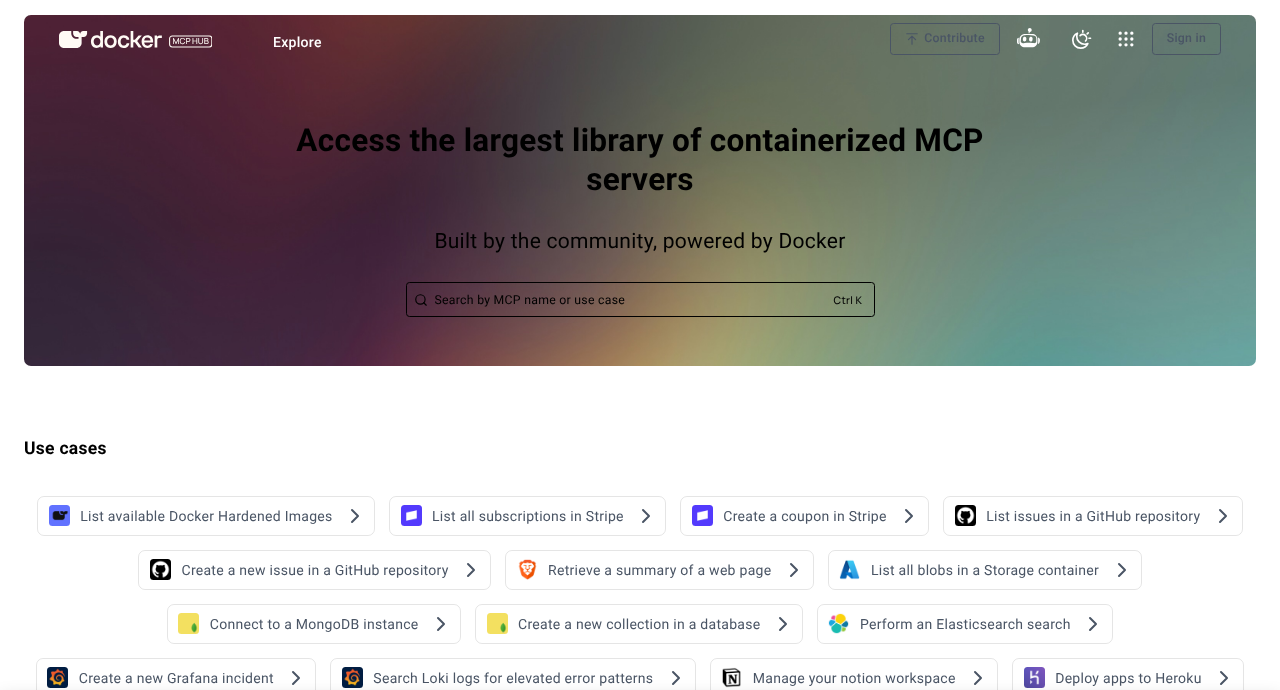 Screenshot of the Docker MCP Catalog, November 2026.
15. Zapier MCP
Zapier MCP turns actions across 9,000+ apps into MCP tools without code.
- Transport and auth: Streamable HTTP only, with OAuth or a connection token. Zapier holds the app credentials, so the agent never sees them.
- Price (November 2026): included on every plan, but each successful tool call uses 2 tasks. The Free plan has 100 tasks a month, which is about 50 calls; Professional starts at $19.99 a month billed annually.
- Who it’s for: non-developers and teams already running Zapier.
16. n8n
n8n works in both directions. Its MCP Server Trigger exposes your workflows as tools to any MCP client, and its MCP Client node lets n8n agent workflows call outside servers. That makes it a practical way to turn workflow automation you already have into tools an agent can call.
- Transport: SSE and Streamable HTTP; no stdio.
- Price (November 2026): the Community Edition is self-hosted and free on GitHub; cloud plans start at $20 a month billed annually (the page shows €20 to some visitors), and the MCP nodes are included from the Starter plan up.
- Limits: the license is n8n’s Sustainable Use License, not open source as the Open Source Initiative (OSI) defines it. In queue mode, all MCP traffic has to go to a single webhook replica.
Two more worth knowing: Gumloop runs its own MCP server with 87 tools and can host one of your servers on its $37-a-month Pro plan, and Pipedream offers managed auth for 10,000+ tools across 3,000+ APIs, free for your own use. Workday agreed to acquire Pipedream in November 2025.
One to drop from older lists: Smithery shut down its hosting, API, CLI and SDKs on October 31, 2026. It is now part of Arcade and stays only as a public directory.
The best SDKs and agent frameworks for MCP
17. FastMCP and the official MCP SDKs
If you need your own server, start here. The official SDKs cover TypeScript, Python, C#, Go, Rust and Ruby at Tier 1, and the Python SDK speaks every standard transport. FastMCP is a higher-level Python framework on top: a decorated function becomes a tool, mcp.run() serves it over stdio, and mcp.run(transport="http") serves it over Streamable HTTP. Its README says FastMCP 1.0 was folded into the official Python SDK in 2024.
- Price: free and open source. FastMCP hosting has a free tier for personal servers.
- Limits: FastMCP moves fast (version 4.2.5 shipped on November 23, 2026), so pin versions.
For remote servers, Cloudflare Workers is a cheap host: Streamable HTTP plus OAuth, on a free tier of 100,000 requests a day.
18. OpenAI Agents SDK
The OpenAI Agents SDK has first-class MCP support through MCPServerStdio, MCPServerStreamableHttp and HostedMCPTool, in Python and JavaScript. OpenAI adopted MCP in March 2025, starting with this SDK.
async with MCPServerStdio(
    name="Filesystem Server via npx",
    params={
        "command": "npx",
        "args": ["-y", "@modelcontextprotocol/server-filesystem", str(samples_dir)],
    },
) as server:
    agent = Agent(
        name="Assistant",
        instructions="Use the files in the sample directory to answer questions.",
        mcp_servers=[server],
)- Price: the SDK is free (MIT). With the Responses API’s hosted MCP tool, you pay only for tokens, with no fee per tool call.
- Limits: hosted MCP needs a publicly reachable server, or OpenAI’s Secure MCP Tunnel for a private one.
19. LangChain and LangGraph
LangChain now ships MCP inside the langchain package (install the langchain[mcp] extra) as langchain.mcp.MCPAdapter, built on FastMCP. Pass it a URL for Streamable HTTP, a path for stdio, or a config with several servers, and it returns tools a LangGraph agent can use.
- Limits: the adapter is labeled beta. The older
langchain-mcp-adapterspackage and itsMultiServerMCPClientare replaced, so many tutorials are now out of date.
20. MCP Inspector
The MCP Inspector is the official debugging tool: run npx @modelcontextprotocol/inspector, connect to any server, and call its tools by hand before an agent does. Keep it updated. Versions below 0.14.1 had a critical remote code execution flaw, tracked in the Common Vulnerabilities and Exposures (CVE) list as CVE-2025-49596.
Other agent frameworks with MCP support
Every major framework now speaks MCP, so pick the framework for other reasons and expect MCP to work:
| Framework | How it connects to MCP | Transports |
|---|---|---|
| CrewAI | mcps field on each agent, or MCPServerStdio / MCPServerHTTP |
stdio, Streamable HTTP, SSE |
| Claude Agent SDK | mcp_servers option; tools need explicit permission |
stdio, HTTP, SSE, in-process |
| Google Agent Development Kit (ADK) | McpToolset |
stdio, Streamable HTTP, SSE |
| Microsoft Agent Framework | MCPStdioTool, MCPStreamableHTTPTool |
stdio, Streamable HTTP |
| Pydantic AI | MCPToolset |
stdio, Streamable HTTP, SSE |
| Mastra (TypeScript) | MCPClient and MCPServer |
stdio, Streamable HTTP |
Two Microsoft notes: AutoGen is archived and gets no fixes, and Semantic Kernel’s README names Microsoft Agent Framework as its successor. Build new multi-agent systems on Agent Framework or another maintained option. Our AI agent builders list covers the no-code side.
Comparison table
Prices and stars as of November 2026. Stars are rounded figures from each project’s GitHub page.
| # | Tool | Type | Transport | Auth | Starting price | Stars |
|---|---|---|---|---|---|---|
| 1 | GitHub MCP Server | Server | Remote HTTP, stdio | OAuth, PAT | Free | 34.7k |
| 2 | Playwright MCP | Server | stdio, HTTP | None (local) | Free | 40.0k |
| 3 | Context7 | Server | Remote HTTP, stdio | Key (optional) | Free, 1,000 calls/mo | 65.3k |
| 4 | Supabase MCP | Server | Remote HTTP | OAuth, PAT | Free plan | 3.0k |
| 5 | Firecrawl MCP | Server | stdio, HTTP | OAuth, key | Free, 1,000 credits/mo | 7.9k |
| 6 | Exa MCP | Server | Remote HTTP | Anonymous, OAuth, key | $10 free credits/mo | 5.3k |
| 7 | Notion MCP | Server | Remote HTTP | OAuth | Every plan | n/a |
| 8 | Atlassian Rovo MCP | Server | Remote HTTP | OAuth 2.1, token | Rovo credits on some tools | 1.2k |
| 9 | Slack MCP | Server | Remote HTTP | OAuth (admin approval) | Not published | n/a |
| 10 | Stripe MCP | Server | Remote HTTP | OAuth, agent keys | No separate fee listed | 2.1k |
| 11 | Sentry MCP | Server | Remote HTTP, stdio | OAuth, token | Free Developer plan | 973 |
| 12 | Reference servers | Server | stdio | None | Free | 92.2k |
| 13 | Composio | Gateway | Remote HTTP | Managed OAuth, key | Free, 100k calls/mo | 31.2k |
| 14 | Docker MCP Toolkit | Gateway | stdio, HTTP | Docker secrets, OAuth | Free in Docker Desktop | 1.6k |
| 15 | Zapier MCP | Gateway | Remote HTTP | OAuth, token | 2 tasks per call | n/a |
| 16 | n8n | Gateway | HTTP, SSE | OAuth2, bearer, header | Free self-hosted; $20/mo cloud | 212k |
| 17 | FastMCP | SDK | stdio, HTTP | OAuth helpers | Free | 28.7k |
| 18 | OpenAI Agents SDK | SDK | stdio, HTTP, hosted | Your config | Free (tokens billed) | 30.8k |
| 19 | LangChain MCPAdapter | SDK | stdio, HTTP | Your config | Free | n/a |
| 20 | MCP Inspector | Dev tool | stdio, HTTP | Per-launch token | Free | 11.3k |
How do you connect an MCP server to your agent?
The details differ by client, but the shape is the same: name the server, then give either a command (stdio) or a URL (HTTP).
- Claude Code:
claude mcp add --transport http notion https://mcp.notion.com/mcpfor a remote server, orclaude mcp add --transport stdio <name> -- <command>for a local one. Project scope writes a shared.mcp.json. - Cursor: add servers to
.cursor/mcp.jsonin the project or~/.cursor/mcp.jsonglobally. Cursor supports stdio, SSE and Streamable HTTP. - Gemini CLI:
gemini mcp add <name> <commandOrUrl>, per its docs. - Windsurf is now Devin Desktop, and its MCP config moved to
.devin/mcp_config.json(Devin). - ChatGPT: custom MCP servers with full access are for Business and Enterprise/Edu workspaces; Pro users get read and fetch only.
- Claude Desktop: edit
claude_desktop_config.json, as in the official local-server tutorial. - In code: use the SDK snippets above (OpenAI Agents SDK, LangChain, CrewAI and others).
Keep API keys out of shared config files. Use OAuth where the server supports it, environment variables or a secrets manager where it doesn’t, and chmod 600 on any file that holds a token, as the GitHub MCP README suggests.
How many MCP tools should an agent have?
Fewer than you think. LLMs pick tools by reading their descriptions, and every tool’s name, description and schema go into the prompt on every turn, and tool results come back into the context window too.
- Anthropic’s engineers found that agents do better with a small set of well-described, consolidated tools, and that “even small refinements to tool descriptions can yield dramatic improvements.” Tool descriptions are prompt engineering, and should be written and tested like prompts.
- Claude Code caps a single MCP tool response at 25,000 tokens by default.
- In one Anthropic example, presenting tools as code that the model reads on demand cut token use from 150,000 to 2,000, a 98.7% saving.
In practice: turn on only the toolsets you need (GitHub, Supabase and Exa all support this), prefer servers with a handful of tools (Context7 has 2) or meta-tools that search for the right one (Composio Connect has 7), and remove anything the agent hasn’t called in a week. In multi-agent setups, give each agent only the servers its own job needs. Good prompt engineering on your side helps as well: tell the agent which server to use for which job.
Are MCP servers safe?
They are as safe as the code and credentials behind them. The spec says plainly that “tools represent arbitrary code execution and must be treated with appropriate caution.” Four public cases show where the risk sits:
- Tool poisoning (April 2025). Invariant Labs showed that a malicious server can hide instructions in a tool description, and that clients like Cursor were susceptible.
- GitHub (May 2025). A prompt injection in a public issue led an agent to leak private repository data into a public pull request. The researchers stressed it was “not a flaw in the GitHub MCP server code itself.”
- Supabase (July 2025). In a General Analysis demo, a support ticket carried instructions that made a Cursor agent with a
service_rolekey read a private table and post it back into the ticket. - MCP Inspector (June 2025). CVE-2025-49596 allowed remote code execution in versions below 0.14.1.
In three of the four cases, the agent obeyed text from untrusted content while holding broad credentials. The fixes are simple:
- Use official servers and pin versions. Check the official MCP Registry, which verifies who owns a namespace but doesn’t vet the code.
- Give each agent the narrowest token you can: one project, one repository, read-only by default.
- Keep human approval on for writes. The Claude Agent SDK, the OpenAI Responses API and Stripe all support it.
- Don’t mix a server that reads untrusted content (email, tickets, web pages) with one that can write somewhere public in the same session.
- Run local servers in containers (the Docker gateway does this) and prefer OAuth over long-lived API keys.
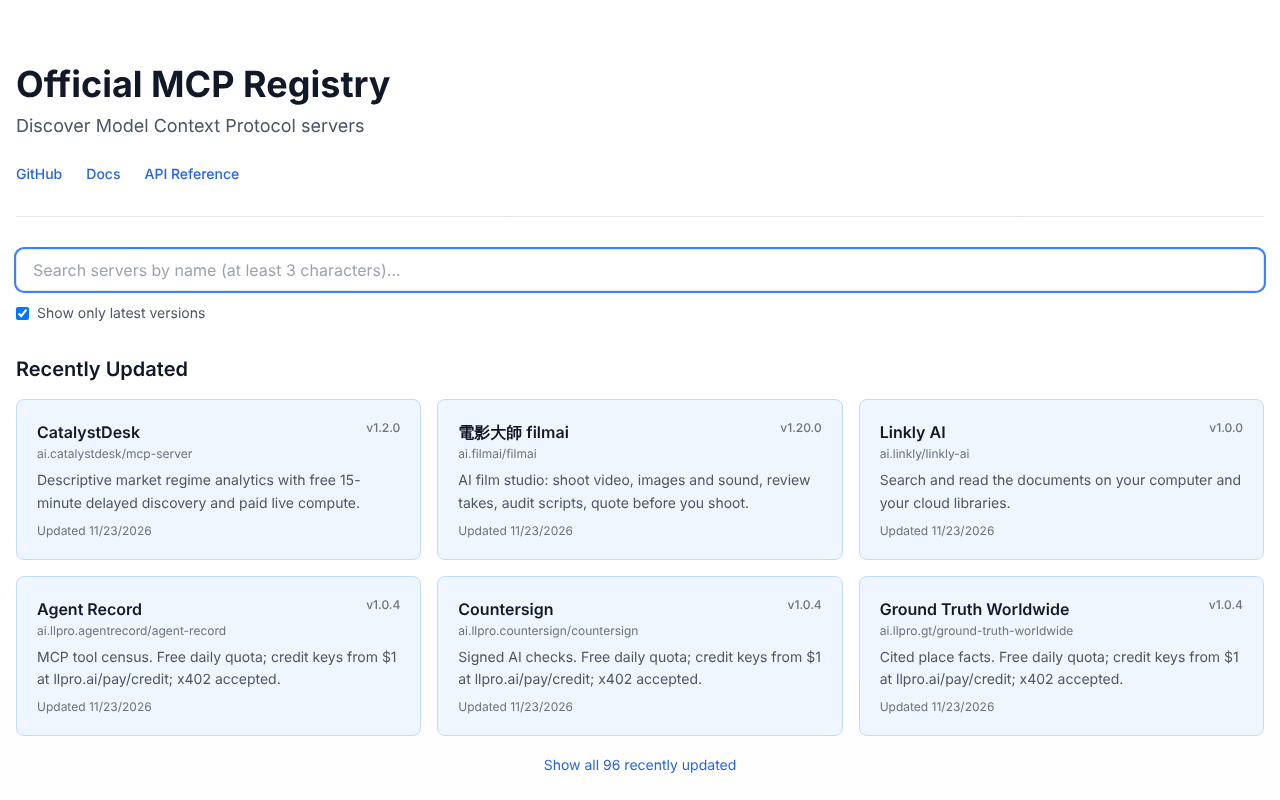 Screenshot of the Official MCP Registry, November 2026.
FAQ
What is the best MCP server for building AI agents?
For most coding agents, the GitHub MCP Server is the first one to add, followed by Context7 for docs and Playwright MCP for browser automation. For agents that serve many users across many apps, a gateway such as Composio does more than any single server.
Are MCP servers free?
Most servers are free to run, but the service behind them may not be. GitHub, Playwright, Notion and the reference servers cost nothing extra; Firecrawl, Exa and Context7 have free tiers with paid usage above them; Zapier charges 2 tasks per call; Atlassian charges Rovo credits on some tools.
Should I use stdio or Streamable HTTP?
Use stdio for servers that run on your own machine next to the agent (Playwright, Filesystem, Git). Use Streamable HTTP for remote, vendor-hosted servers and for anything several agents or users share. Avoid SSE-only servers: SSE was deprecated in the March 2025 spec, and Zapier and Slack don’t accept it.
Do I need to build my own MCP server?
Only for internal systems nobody else has wrapped. For public APIs, check the MCP Registry first; when we paged through its API on November 23, 2026, it listed more than 70,000 server names. If you do build one, FastMCP or the official TypeScript SDK gets you a working stdio server in a few lines.
What’s the difference between MCP and function calling?
Function calling is how a model asks to run a tool. MCP is how that tool is described, discovered and reached, in a standard way that works across clients. An MCP client still uses the model’s function calling underneath; MCP means you write the tool once instead of once per framework.
Which agent frameworks support MCP?
All the major ones as of November 2026: the OpenAI Agents SDK, LangChain and LangGraph, CrewAI, the Claude Agent SDK, Google ADK, Microsoft Agent Framework, Pydantic AI and Mastra. Coding agents such as Claude Code, Cursor, GitHub Copilot, Codex and Gemini CLI act as MCP clients too.
Is MCP an Anthropic-only standard?
No. Anthropic created it, but it now sits in the Linux Foundation’s Agentic AI Foundation, and OpenAI, Google and Microsoft products support it. Gemini support was announced at Google I/O 2025.
Looking for agents to run these tools? Browse the best AI agents for coding, the best agents for workflow automation, self-hosted options, or compare n8n, Zapier Agents and Make.