
From November 16 to 22, 2026, OpenAI, Google and Microsoft all shipped new models within two days, each pitched on what agents cost to run. Cognition and Replit both launched products where one agent manages a team of others, and investors put $433.2 million into five confirmed agent rounds, led by Model ML.
The big one: three labs ship cheaper models for agent work
OpenAI released GPT-6.2 Astra and GPT-6.2 Sol on November 17, as Digital Trends reported. Astra costs $8 per million input tokens and $40 per million output tokens. Sol stays at $2 and $10, the same as GPT-6.1 Sol. Both are in ChatGPT Work for Plus, Pro, Enterprise and Edu users, in Codex, and in the API (application programming interface). OpenAI says Astra scores 5.2 points higher than GPT-6 Astra on Agents’ Last Exam “at less than a third of the cost”, and uses 22% fewer output tokens on GDPval v2. The launch drew 1,347 points on Hacker News.
A day later Google released Gemini 4 Neon at $3 and $15 per million tokens, with a 1 million-token context window. It sits between Carbon, for the hardest long projects, and Hydrogen, for fast everyday work. In Google Antigravity, Neon can act as an orchestrator that directs Hydrogen subagents working in parallel. Google reports it ranks first on the Artificial Analysis Coding Agent Index (58.6) and on AutomationBench (56.3%), and scores 65.2% on Terminal-Bench 4.1.
Microsoft used its Ignite conference to launch MAI Code 2 and MAI Code 2 Flash, both available now in GitHub Copilot. It gave no per-token prices, only ratios: MAI Code 2 delivers 98% of GPT-6.1 Sol’s performance at 40% of the cost, and 96% of Claude Opus 5.5’s at 5% of the cost, averaged across four coding benchmarks. Microsoft says neither model is tuned yet for very long-horizon agent work. The pair is part of a family of new models that Microsoft says is built so “monitoring and control agents” can run around the clock.
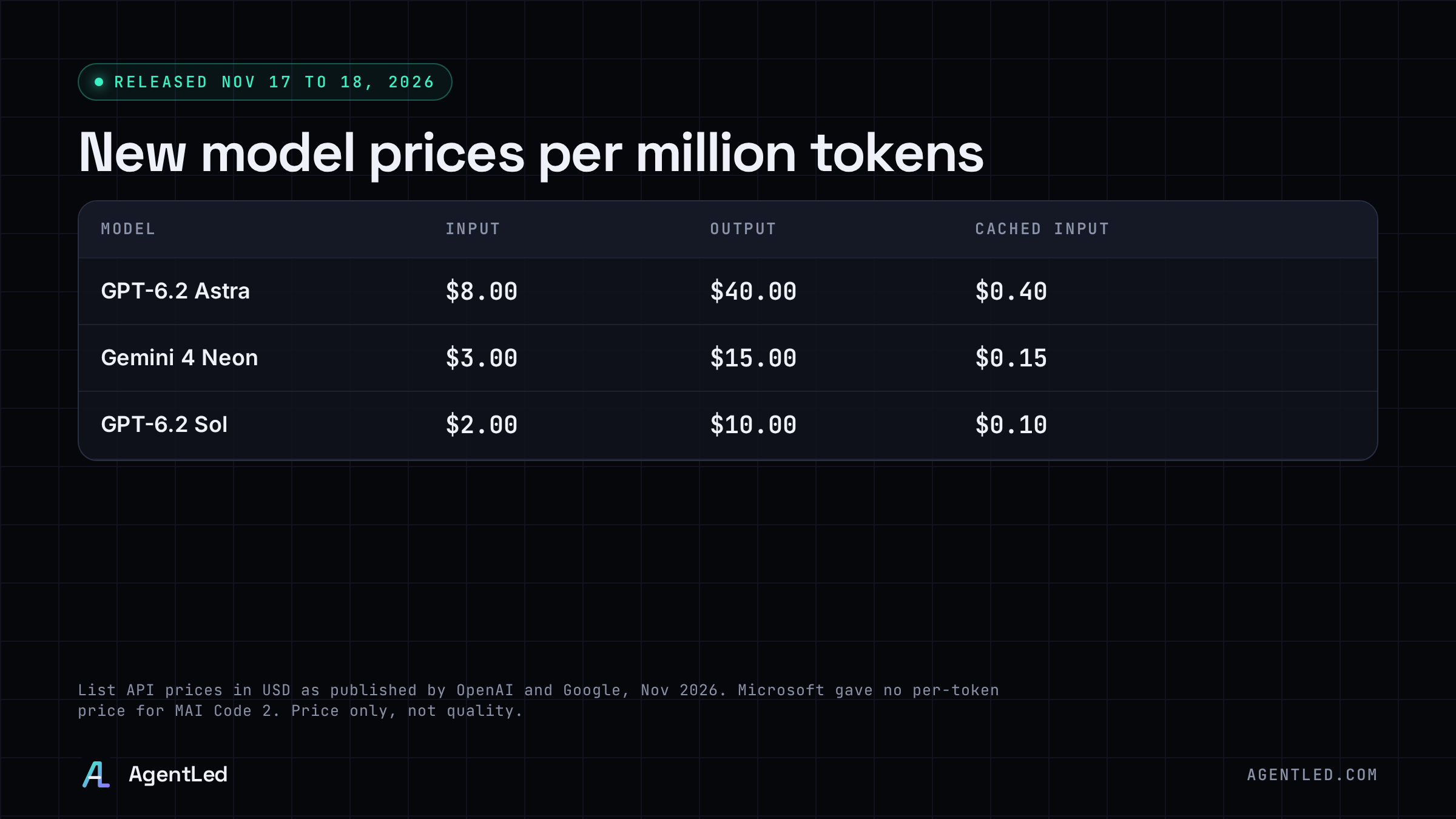 List API prices as published by OpenAI and Google. Microsoft gave no per-token price for MAI Code 2, so it is not in the table.
All of these numbers come from the vendors themselves, and each picks different benchmarks, so none of them settles which model is best. What they do agree on is the pitch: an agent that runs many steps, or many subagents, spends most of its budget on tokens, so every lab is now selling on cost per finished task. If you choose a coding agent today, check which models it lets you switch between, because three new options arrived this week.
Quick hits
Microsoft’s Agent 365 now finds Claude Code on employee laptops
Microsoft says organizations have registered more than 50 million agents in Agent 365 since it launched in May 2026. Defender and Entra Global Secure Access can now discover “more than 60 local AI agents, such as Claude Code and GitHub Copilot CLI”, along with the Model Context Protocol (MCP) servers they are configured to use. Discovery in Defender is generally available; giving those local agents their own Entra Agent ID, starting with Claude Code and GitHub Copilot CLI, is in preview. For IT teams, coding agents that developers install themselves are now something the security stack can list and restrict.
Cognition launches Devin Bots to manage teams of Devins
Cognition launched Devin Bots, persistent agents that split a project among several Devin coding agents, join a team’s Slack, keep context across weeks and ask a person when they are blocked, Fortune reports. Early-access customers include Decagon, Fireworks AI and Reducto, and Cognition says Bot usage among them grew tenfold in two weeks. No pricing was given; each Bot can have its own budget.
Replit Missions runs swarms of agents against a budget
Replit Missions from the maker of Replit Agent, lets a user set an outcome, a spending cap and approval rules, then runs several agents in parallel while a separate AI judge checks the result. On 13 NumPy tasks with its Auto (Max) setting, Replit says a single agent reached speedups of up to 4x, a 16-agent swarm 17x and a 32-agent swarm 19x. Replit says it built its own monitoring app, DataCat, “in two days, within a $3,000 budget”. To start one, users click “New” in the sidebar and choose “Mission”; plans and pricing were not listed.
LangChain puts a gateway in front of agent tools
LangChain opened a public beta of LangSmith Tool Gateway, “a managed tool layer that handles credentials, identity, and access for every agent tool call.” Agents reach tools through one URL, policies decide what each call may do, and every call is logged as a trace. Built-in servers cover Google, Microsoft, Salesforce, GitHub and Linear, with no login app to register. Like Microsoft’s news, it puts the controls around the agent rather than inside it.
Signal blocks operating-system AI agents from reading chats
Signal now blocks screenshots on iOS 27 and adds a “Block Siri AI” setting. On Android it turns on Screen security automatically “when AI assistants attempt to capture screen data”. It can’t do the same on macOS yet. Signal asked Apple, Google and Microsoft for a way for apps to opt out of AI data access. Agents that work by reading the screen should expect more apps to refuse them.
OpenRouter drops three inference providers over data handling
After security researchers reported that some inference providers had data compromised or were not following their data policies, OpenRouter off-boarded three providers and removed 125 endpoints from Zero Data Retention eligibility. It names Atlas Cloud, Novita, Phala and Together as providers that published security notices, including a Together “prompt leakage” event in June and July 2026. If your agent routes through an aggregator, the provider behind it is part of your data policy.
Anthropic starts trading on Nasdaq
Anthropic, the maker of Claude Code, began trading on November 19 under the ticker ANT after pricing at $83 per share and raising $81.3 billion. It went live at $111.50, 34% above the offer price. Buyers of its agents can now read its results in public filings.
Thinking Machines releases a laptop-sized open model for coding
Thinking Machines released Inkling 2 Mini with open weights: 26.4 billion parameters, 3.4 billion active per token, about 20GB of memory. It reports 79.2% on SWE-bench Verified (bash only) and 71.6% on Terminal Bench v2.1. It drew 1,466 points on Hacker News, the most of any AI story this week.
Money moves
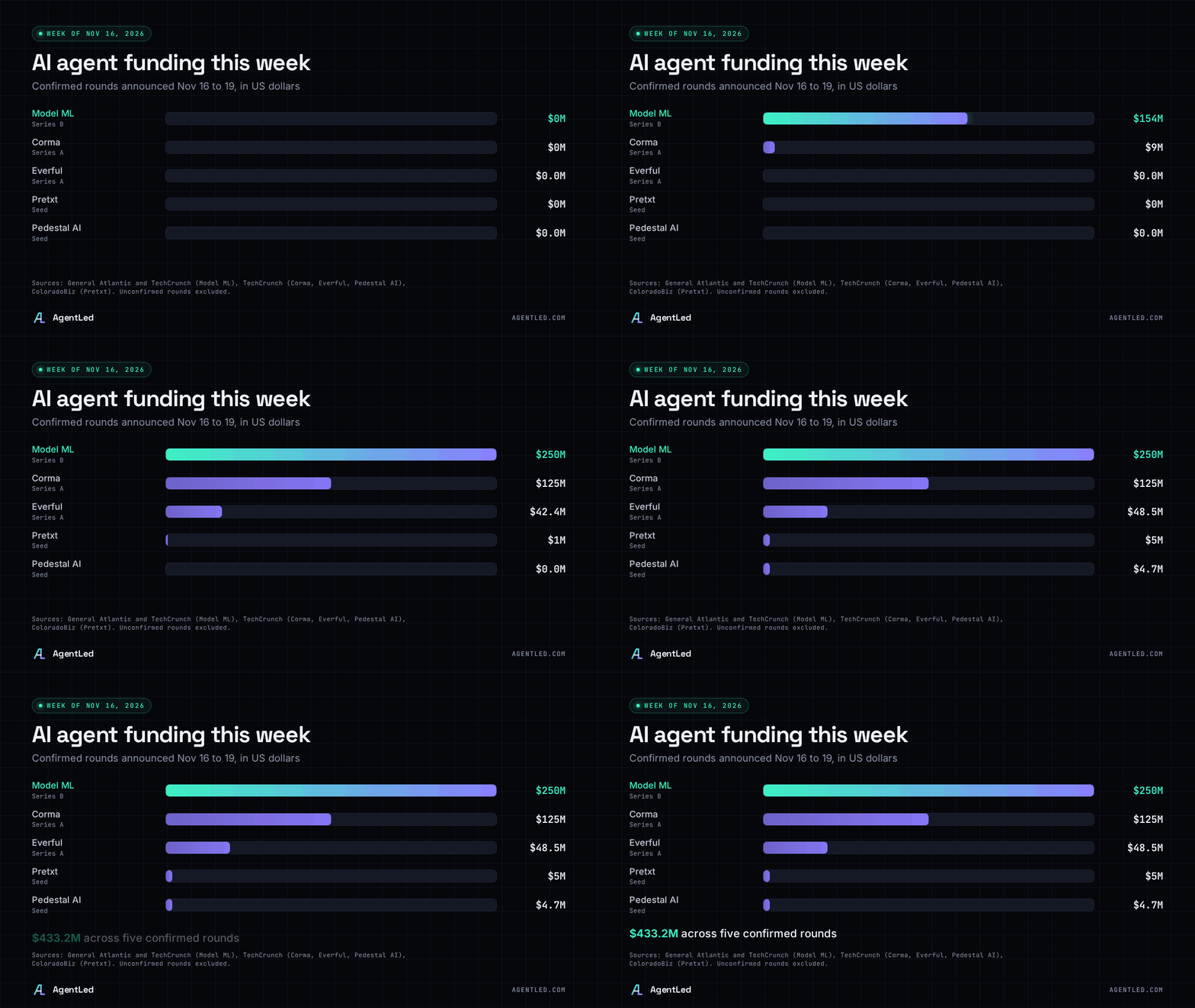 Confirmed rounds announced November 16 to 19, 2026. Unconfirmed rounds are left out.
| Company | Amount | Round and lead | What it builds |
|---|---|---|---|
| Model ML | $250M at a $1.5B valuation | Series B, co-led by General Atlantic and QED Investors | AI agents for bankers, consultants and investors that work in Excel and PowerPoint |
| Corma | $125M at a $1B valuation | Series A, led by NEA | AI models and agents trained for cyber defense |
| Everful | $48.5M | Series A, led by Vertex Ventures Southeast Asia & India and January Capital | Agents that identify suppliers, coordinate orders across factories and manage logistics for retailers |
| Pretxt | $5M | Seed, from Deciens Capital, Howdy Partners, NSV Wolf Capital and Service Provider Capital | Checks an agent’s proposed actions against a company’s rules |
| Pedestal AI | $4.7M | Seed, led by Eclipse | Supply-chain agents, such as calling customers before furniture deliveries |
Model ML’s round brings its total funding to $350 million, per General Atlantic, and TechCrunch notes it came a year after a $75 million Series A. Pretxt follows last week’s Bay round: a second company funded to check what agents do while they run.
In the directory this week
AgentLed now lists 738 AI agents, builders and platforms: 297 full, scored profiles and 441 basic listings. We added Meta Muse, Meta’s personal agent, and Strawberry, a browser with built-in AI companions, as basic listings. We also published three-way comparisons for the most searched match-ups, including Cursor vs Claude Code vs Codex and OpenHands vs Devin vs Manus.
One more thing
Architect Labs says it designed a new CPU, Frostbite, with a new instruction set, by letting AI agents iterate on everything from the compiler to the final chip layout. Swarms tested 58 ideas in parallel and kept 37, and the company says one scheme for sharing work between cores “was never specified by any human.” On its own numbers, Frostbite delivers 4.59 times the performance per watt of an unnamed modern in-order core across 25 workloads. The final layout is in a 7 nm process at 500 MHz.